After three years, I thought I’d spruce things up a bit. Please check out my new site at http://www.manilaartblogger.com. Hope you continue to follow me as I chronicle Manila’s art scene!
Manila Art Blogger’s New Site
October 4, 2011
 1 Comment |
  Uncategorized |
  Permalink
 Posted by manilaartblogger
Lyra Garcellano’s Epistolary
September 6, 2011
Lyra Garcellano, "Aria"
After disappearing for a year, spending six months of 2010 in an Asian Cultural Council grant in New York, Lyra Garcellano has come back with wonderful new work. In Epistolary, her solo exhibit at Finale Art File, Lyra has treated us to five paintings she describes as imprints. Faint figures whisper from her canvases, barely discernible through her loose pastel strokes. All of women, their floral frocks blur into the background, creating sheer, almost abstract, patterns. Her paintings have always stood out for their delicacy and softness, and evoke a sense of romantic melancholia. This set keeps to that sensibility, progressing naturally from her previous pieces. To me, they seem to project a more confident Lyra.

Lyra Garcellano, "Etcetera"
The show runs as one of three, all by women artists. At Finale’s Tall Gallery, Keiye Miranda Tuazon has turned portraits into giant lockets for her show Strangely Familiar. Marija Vicente, meanwhile, has taken over the gallery’s Video Room.

Lyra Garcellano, "Pentimento"
Epistolary by Lyra Garcellano, Strangely Familiar by Keiye Miranda Tuazon, and something something by Marija Vicente run from 2 to 27 September 2011 at Finale Art File, Warehouse 17, La Fuerza Compound, 2241 Pasong Tamo, Makati City. Phone (632) 813-2310 or visit http://www.finaleartfile.com

Lyra Garcellano, "Aria" and "Mise-en-Scene"

Lyra Garcellano, "Enamore"

Keiye Miranda Tuazon's locket portraits

Marija Vicente, "something something", exhibit installation view
Leave a Comment » | arts and culture, philippine contemporary art | Tagged: epistolary, Finale Art File, finale art gallery, keiye miranda tuazon, lyra garcellano, manila art blogger, Marija Vicente, something something, strangely familiar | Permalink
Posted by manilaartblogger
Sun Yuan and Peng Yu’s Hong Kong Intervention, Alfredo + Isabel Aquilizan’s Address, and Sandra Palomar and Nolet Soliven’s Flesh at UP Vargas
September 2, 2011
Artists Sandra Palomar and Sun Yuan
I’m a big fan of Chinese artists Sun Yuan and Peng Yu. Ever since I saw Angel, a hyper realistic sculpture of a dead angel splayed on the ground, I have sought to keep abreast of their work. Made from silica gel and fiberglass, the most striking feature possessed by the wrinkled seraphim is a pair of molted wings. His feathers have withered away, and instead, he is left with wings of flesh and bone; they resemble chicken wings after they’ve been dressed. I saw it when it came up for auction last year.

Hong Kong Intervention, installation view
Another celebrated piece, Old Persons Home, also works with silica gel and fiberglass fabricated by the pair into elderly personages. In this one, the artists assembled a group of world leaders (Churchill and Arafat, to name a few), sculpted as doddering and drooling ancients on electric wheelchairs. Famously exhibited at the Saatchi Gallery in London, the figures would occasionally bump into one another as their wheelchairs moved about the space.

Hong Kong Intervention, installation view
When I heard that the duo would bring one of their more recent pieces to Manila, I made sure to make the time to meet them. They have worked together to produce a whole range of work, frequently causing controversy for their audacious use of materials (baby cadavers and human fat). Unfortunately, only Mr. Sun travelled to Manila. Ms. Peng could not get a visa in time, and stayed in China.
Hong Kong Intervention, from 2009, and reprised at the 2010 Sydney Biennale, currently runs

Hong Kong Intervention, installation view
at the Jorge B. Vargas Museum in UP. A project that involved 200 Filipino domestics in Hong Kong, the piece debuted at Osage, a gallery for contemporary art in the SAR. It is through the cooperation of the Osage Foundation that this work made it to Manila. Perhaps, this counts as one of the duo’s tamer pieces, but it does ring close to home.

Hong Kong Intervention, detail
For this piece, the artists gave each of the Filipino OFWs a toy grenade. The Pinoys stuck their grenades around the houses they work in and then photographed them. They paired each of their resulting photos with one of themselves with their backs turned, concealing their identities from viewers. One gets a thrill out of looking over the photographs mounted on the Vargas Museum walls. You feel like an intruder allowed a forbidden peek, or an eavesdropper who unwittingly stumbles on an intimate conversation. It is also fascinating to examine the images, guessing at the lifestyles suggested by the spaces. In a sense, this mischievous piece captures the Pinoy penchant for chismis, for making uzi, for the unwarranted way we stick our noses into other people’s business. If only the amos knew what their household helpers were up to when they weren’t around!

Hong Kong Intervention, detail
Address, a piece by another artistic tandem, has been mounted at the museum’s lobby. This one, by Alfredo + Isabel Aquilizan, touches on the process of migration, an issue frequently tackled by these two artists. It is one familiar to the subjects of Hong Kong Intervention. The two exhibits relate to each other through this common thread.

Hong Kong Intervention, detail
In Address, we see rows of balikbayan boxes set beside what we presume to be rows of their contents, all precisely arranged. They signify life stories reduced and compressed into cubes, transported and transposed into alien territories.
Sandra Palomar and Nolet Soliven have installed Flesh at the museum’s third floor space. The exhibit illustrates their reactions to work in the Vargas Museum collection. They deliberately chose two nudes made by uncelebrated artists (Nude Study, Marcelino Sanchez, 1935 and Sultana, Antonio Dumlao, undated), and dictionaries that translate Filipino tribal dialects.

Alfredo + Isabel Aquilizan, "Address"
Nolet’s Fleshcape dominates the space, bisecting the room. He draws and paints magnified impressions of female body parts on both sides of a long sheet of paper. Sandra’s Reflection Piece 001 stands between this and the Sanchez painting. One is meant to peep inside to see refracted impressions of both the nude and Nolet’s work.

Another view, Alfredo + Isabel Aquilizan, "Address"
On the other end of Nolet’s drawing, Sultana is posed atop a set of drawers. Arranged inside the drawers are the dictionaries, vintage photographs of tribal Filipinos, an image of Nora Aunor, and some sculpture. Like the kayumanggi in the painting, the assortment celebrates our Filipino ethnicity.
Interview and translation exercise 001 is a video by Sandra. It includes the written recollection of a young Manobo’s initial experiences in Manila. A transplant into the capital city, he too is a migrant— like the domestics photographed for Hong Kong Intervention. He knows only too well the displacement explored by the Aquilizans in Address.

Nolet Soliven, "Fleshscape", detail
Hong Kong Intervention, Address, and Flesh run from 31 August to 29 October 2011 at The Jorge B. Vargas Museum and Filipiniana Research Center, Roxas Ave., University of the Philippines, Diliman, Quezon City. Phone (632) 928-1927 or visit http://www.vargasmuseum.org

At right, Marcelino Sanchez, "Nude Study"

Antonio Dumlao, "Sultana" over an open set of drawers

A peek inside "Reflection Piece 001"

Sun Yuan and Peng Yu, "Angel", image from Christies.com

Sun Yuan and Peng Yu, "Old Persons Home", image from rebelart.net
3 Comments | arts and culture, philippine contemporary art | Tagged: address, alfredo and isabel aquilizan, flesh, hong kong intervention, manila art blogger, nolet soliven, peng yu, sandra palomar, sun yuan, sun yuan and peng yu, up vargas museum | Permalink
Posted by manilaartblogger
ManilArt 11: Art In The Dark
August 27, 2011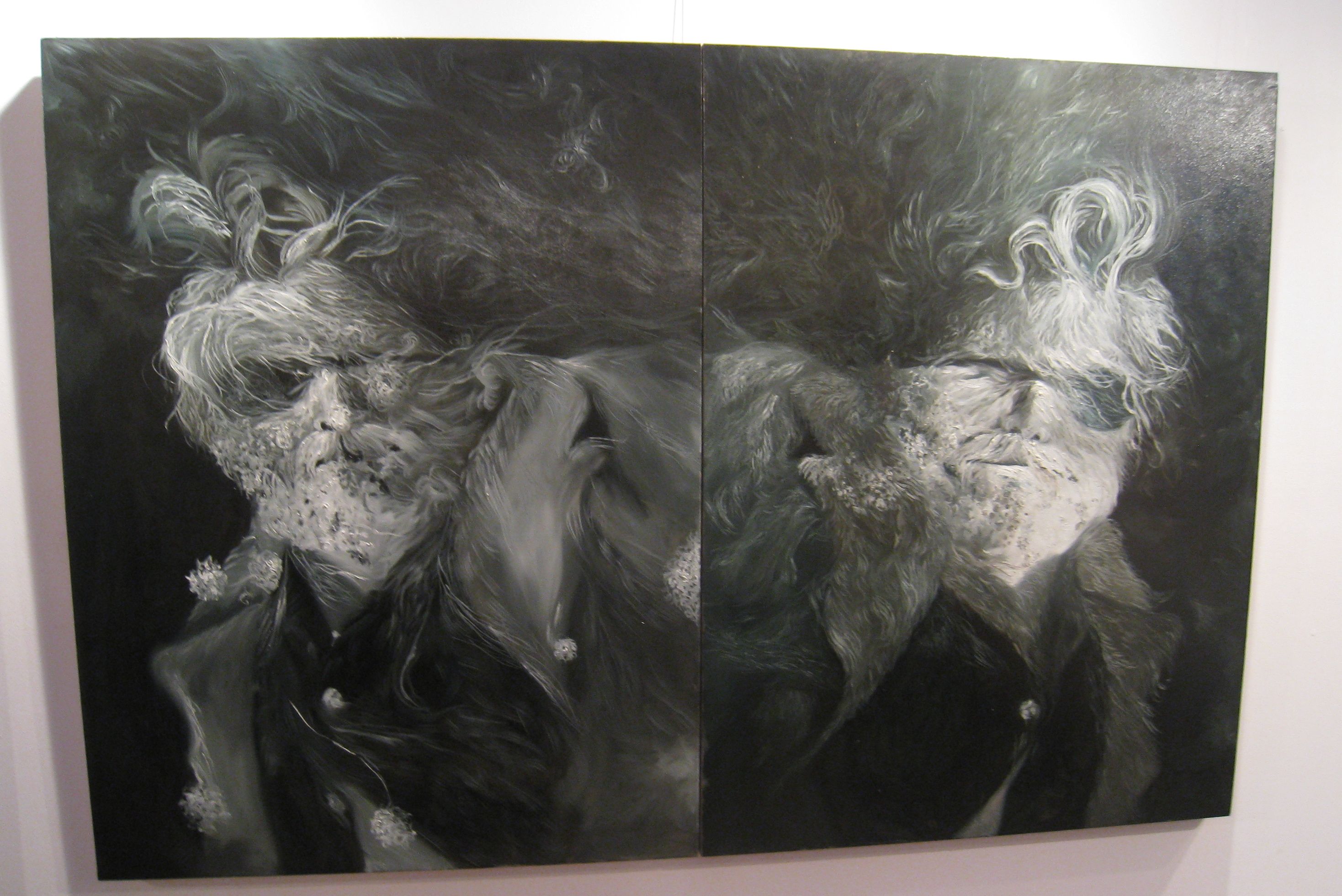
Tatong Recheta Torres, "Untitled" at Art Informal
The invitation said be there at six, and I thought I’d be fashionably late. I arrived close to seven pm, wondering if I could get away with not strictly following the Filipiniana dress code. I need not have stressed. I got there to find the venue in darkness, tons of people jostling about in the sidelines, trying to get past usherettes standing guard, preventing guests from crossing the red cordon that ringed the venue. Apparently, the ribbon had yet to be cut. Music blared from a stage at the far end where song and dance numbers were going on. Was this an art fair? The crowds could but peer at the pieces on display as tempers flared. Incredibly, this state of affairs continued for an hour and a half, until the last politician had given what sounded like filibuster from a privilege speech. Only then did the lights come on. A surreal, truly chaotic, Only in da Pilipins, tableau unfolded on the vernissage of our city’s sole art fair.

Dex Fernandez, "Suspend" series at Pablo
This opening night debacle definitely cast a pall on ManilArt 11. On paper, this fair seemed to have everything going for it. The organizers scaled it down to 24 galleries but set aside bigger spaces for each participant. They chose to mount it at the highly accessible NBC Tent at the Bonifacio Global City in Taguig. And once the lights turned on, I could tell that my favorite galleries prepared new pieces especially for the event. The physical arrangements, though, seemed to diminish their efforts.

Leeroy New's solo exhibit "Terrorium" at Manila Contemporary
Manila Contemporary, for instance, opted for a solo show by Leeroy New. He brought in freestanding hybrid creatures, lit from within hallowed out bellies filled with multi-colored plastic toys. The gallery, however, could not get permission to paint the walls of their booth. Why? Leeroy’s work deserved a proper setting.

Leeroy New, "Terrarium IX" at Manila Contemporary
Pablo got around this restriction by bringing their own panels to the fair. A wise choice as, once again, they had the best booth. But why would they have to resort to that? They carried works by Dex Fernandez, Jason Moss, and the fantastic duo of Ivan Despi and Pauline Vicencio. The booth’s layout managed to squeeze in a room where Ivan and Pauline’s video, Babel, played. I’d love to see what else these two come up with. Exciting things seem to be in store for this talented twosome.

Ivan Despi and Pauline Vicencio, "Babel", video still at Pablo
Dex exhibited his Suspend series, a variation on his manipulated photographs. This time he altered his photos with cut outs—patterns he painted and illustrated then cut and pasted onto his images.

Maria Jeona Zoleta at Finale
Maria Jeona Zoleta lorded it at Finale’s booth. She made the gallery stand out in neon pink glory. Blanc brought out new pieces by Art Sanchez, an impressive Lao Lianbien, and various Louie Cordero paintings on canvas and on paper. I just love Louie’s kitschy, Pinoy komiks, over the top, slasher aesthetic.
Art Informal had a wonderful new Tatong Recheta Torres. We must really welcome Tatong back into his first life— and never allow him to leave again! Silverlens, the art fair pros, simply knew how to work their booth. Patty Eustaquio’s Diving Bell (Cloud Country) took center stage, a teaser for her upcoming show. They also had pieces by Leslie de Chavez, Ryan Villamael, Chati Coronel, Isa Lorenzo, and pyrographs on wood by Mariano Ching. As always, Nano rocks!

Mariano Ching, "Pillars Series 3" at Silverlens
New discoveries: Jacob Lindo at Silverlens with his small graphite works, and Carina Santos at West Gallery. She exhibited Joseph Cornell-like boxed assemblages using sliced books. Unfortunately, I don’t have any photos of those.

Lee Amante, Rachel Rillo, and Isa Lorenzo beside Elaine Navas, "Polidori's Sofa" at Silverlens

By Jacob Lindo, "Avoid Rivers, Strivers, and Voyeurs" at Silverlens
Speaking of West Gallery, they seem to have been the only ones who came prepared with a handout that detailed their available pieces. It also outlined a schedule of their upcoming shows.
Over at Duemila, a very tame, almost pretty, Mideo Cruz painting hung on one wall.
CANVAS debuted a novel initiative utilizing the iPad. Rizalpabeto borrows from the tradition of Letras Y Figuras, a 19thcentury art form whereby artists rendered letters of the alphabet, usually to spell out a patron’s name, in stylized forms.

Jay Pacena and Marika Constantino, curators of Rizalpabeto project
This project celebrates Jose Rizal’s 150th birth anniversary. Vim Nadera composed a poem on the National Hero, one verse for each letter of the alphabet. Elmer Borlongan executed a letra for each of the verses, but did this completely on his iPad. A colonial genre has been taken to the 21st century.
My verdict on ManilArt 11? A handful of galleries spent time and effort to bring out new works for collectors to acquire. I found pieces that I did want to take home, more this time than in the last two fairs. Nothing groundbreaking, as the galleries played it safe. They predominantly kept to the two-dimensional and wall-bound. A good number of the participants, though, as in the past, seemed to have simply emptied their backrooms.

Elmer Borlongan's "K" from the "Rizalpabeto" project

Dr. Joven Cuanang at Boston Gallery. He sits on a piece by Plet Bolipata
The flimsy fixtures gave the fair a shabby air. Unfortunately, the galleries who worked to spruce up their spaces could not overcome this overall impression. It felt like a bazaar. And as much as I preferred the NBC Tent’s accessibility, it probably isn’t suited to this event.
Did the fair mirror our dynamic art scene? Unfortunately not. Neither did it seek to educate and elevate standards. A pity, and a missed opportunity, as judging by the number of people that took the time to drop by, ManilArt 11 captured quite an audience.
ManilArt 11 runs from 24 to 27 August 2011 at the NBC Tent, Fort Bonifacio Global City, Taguig. Visit http://www.manilart.com

Secret Fresh

Elmer Borlongan, "Duyan Sa Kwarto" at Boston Gallery

Jason Moss at Pablo

Pablo's installation

Pancho Francisco, Marina Cruz, and Rodel Tapaya at Art Informal

Patty Eustaquio, "Diving Bell (Cloud Country)" at Silverlens

Leslie de Chavez, "Hungry Gods" at Silverlens

Kaloy Sanchez, "Untitled" at Paseo Gallery

Gabby Barredo at Art Verite

Lynyrd Paras, "Huwag Mong Sirain Ang Isang Bagay Na Totoo" at Art Verite

Pow Martinez and Soler Santos by West Gallery space

Jigger Cruz, "Plinth for the Psychedelics" at West Gallery

West Gallery installation

Art Sanchez, "Impermanence 1" at Blanc

Janet Balbarona and her painting at Blanc

Louie Cordero with Eric Encinares of The Sleepyheads

Louie Cordero, "Space Is The Haze" at Blanc

Louie Cordero, " Magnovelzum", "Arvidzwarn", and "Masangoturp"at Blanc

Blanc installation

Photos by Rudolf Schwarkogler at Galerie Zimmerman Krachtowill

Pieces by Robert Langenegger at the Galerie Zimmerman Krachtowill

At Galleria Duemila, paintings by Romina Diaz and Mideo Cruz

Rodel Tapaya, "Camp Scene No. 1", oil on acrylic with chrome frame at Blueline

In the neighborhood: Sonny Angara, Louie Bate, Jia and Gabby Estrella

Andres Barrioquinto, "Twin Shadow" at Blueline

Winner Jumalon, "Pause" at Blueline
5 Comments | arts and culture, philippine contemporary art | Tagged: manila art, manila art 11, manila art blogger, manila art fair, manilart 11, nbc tent | Permalink
Posted by manilaartblogger
Pow Martinez Destroys Planets
August 24, 2011Pow Martinez liberally throws around the word astig. He uses it nonchalantly, with a casual shrug.

Pow Martinez, "Punk House #1", detail

Exhibit installation view
George Condo, the American artist who paints caricature-like figures with pursed lips, bulging eyes, and scrunched up heads? He’s astig. Philip Guston and his cartoonish renderings? Yup, him too. Ditto the Scottish animator David Shrigley, and provocateur Dash Snow, he of the hedonistic lifestyle who died of an overdose two years ago. On the local front, the word is reserved for the likes of Manuel Ocampo and Jayson Oliveria, purveyors of chaotic and sexually explicit images.
Clearly, the inclinations of this boyish, 28-year-old Ateneo Art Awards winner do not lean towards order and discipline, or anything remotely intense. He admits that his decision to become an artist stemmed from a distaste for academic work. “Hindi ako mahilig mag-aral”, a realization that prompted him to attempt UP College of Fine Arts. He discovered that that too required some sort of effort. Pow moved to Kalayaan College’s program after UP kicked him out for his grades (“Sumobra sa inom at sa jutes!”).

Pow Martinez, "Earth 3040 1"
While in Kalayaan, classmate and friend, Robert Langenegger, drew him to the independent art space Big Sky Mind where Roberto Chabet, the iconic UP professor and former director of the Cultural Center of the Philippines, conducted workshops and lectures.

Pow Martinez, "Earth 3040 2"
“Para siyang Jedi Master”, Pow describes Chabet, considered by Manila’s art community as the pioneer of Philippine conceptual art. Here he found kindred spirits. “I realized na puede pala yung ganun, yung art na impolite, na messy. Yung art na gusto ko.”
Initially, Pow was drawn to more conceptual works, producing sound installations that jive with his predilection for punk music. He decided to paint two years ago, filling his canvases with thick dabs and smears of brightly colored paint, with crude figures that gravitate to the lowbrow, a nod to German artist Jonathan Meese (another astig). He called his paintings ridiculous. But that 2009 exhibit at West Gallery, 1 Billion Years, wowed the Ateneo Art Awards panel of jurors for its refreshing move away from the photorealistic images that permeated the auction circuit.
Three more solo exhibits have since followed: Hyper Blast Abominations in Mag: net and March of the Pigs at LOST Projects in 2010,

Pow Martinez, "Wreck Yard #1" and "Wreck Yard #2"
and Cut Hands Has The Solution, a return to West Gallery early this year. In between, Pow has been featured in numerous group shows. He also participated in a survey of contemporary Philippine art organized by Manuel Ocampo for the Freies Museum in Berlin last October. He laughingly recalls how one of the museum visitors told him that his work was the worst painting he had ever seen in his life. “Ok lang ‘yon. I want my paintings to take up your space. Na touch ko pa rin siya.”
Destroyed Planets, Pow’s solo exhibit at Pablo Fort, has drawings, paintings, an installation piece, and featured a performance from Pow on opening night. His paintings and drawings keep to his cluttered, rough, and raunchy aesthetic, but play with more abstracted forms.
For someone with such a laidback, relaxed approach to art, Pow counts among the busiest of today’s young visual artists. Concurrent to the Pablo show, he has a two-person exhibt at DAGC Gallery, and has works on view at NOW Gallery. He draws every day, filling sketchbooks in the Commonwealth Avenue studio he shares with girlfriend and fellow artist, Maria Jeona Zoleta.
There is an authenticity that emanates from Pow’s work despite his seemingly inconsequential subjects. He brushes off his success, almost as if it were accidental, even irrelevant. He would not do things any other way. As he scans the half-finished canvases that lean against the walls, Pow describes the essence of what he hopes to convey: “What if gago ang mundo?”
Is that astig or what?

Pow Martinez, "Destroyed Planet #3", detail
Destroyed Planets runs from 20 August to 24 September 2011 at Pablo Fort, Unit C-11 South of Market Condominium, Fort Bonifacio Global City, Taguig. Phone (632) 5060602 or visit http://www.pablogalleries.com
An edited version of this post appears in the August 2011 issue of Rogue Magazine. See http://www.rogue.ph
1 Comment | arts and culture, philippine contemporary art | Tagged: destroyed planets, manila art blogger, pablo fort, philippine art, philippine contemporary art, pow martinez | Permalink
Posted by manilaartblogger
Snippets from the Bacolod Art Scene
August 23, 2011
Gallery Orange
Amidst wandering through marvelous old mansions, faded reminders of a genteel past, and overindulging in muscovado-laced delicacies, a cultural tour of Bacolod included glimpses of the city’s contemporary arts landscape. The scene seems to gravitate towards two venues, at least as far as I could tell from a three-day stay.

At Gallery Orange entrance
Bacolod native, painter Charlie Co runs Gallery Orange, a downtown space for homegrown talent. We caught Illusion Allusion by Peter James D. Fantinalgo at one of the gallery’s three exhibit areas. He exhibited photorealistic paintings that showcase his skill at trompe l’oeil, and an interesting set that incorporated imprints of his jeans. At the upper level, Guen Decena mounted an installation she calls Constant Point of Vanishing. Both just in their twenties, their efforts are admittedly raw, but do display earnest attempts at working with their

Peter James D. Fantinalgo with one of his paintings
concepts. I thought Guen’s black and white work had panache. She’s off to Manila soon, to undertake a residency with Leslie de Chavez’s Project Space. She’s also slated for an exhibit at Alliance Francaise in 2012.

Guen Decena and her installation "Constant Point of Vanishing"
Charlie and his wife Ann (who bakes a mean sansrival) invited us to his studio where we enjoyed perusing his drawings and checking out some of his works in progress.

Peter James D. Fantinalgo, "The Realistic Idea of the Real"

Illusiion Allusion installation view

Peter James D. Fantinalgo, "Bequest"

More paintings by Peter James D. Fantinalgo

Guen Decena, "Constant Point of Vanishing", detail

Guen Decena, "Constant Point of Vanishing", detail
Capitana Gallery occupies a section of Balay Ni Tana Dicang, a restored family home-turned museum in Talisay. The gallery operates as an extension of Avellana Art Gallery.

Mac Valdezco, "Pink Suit"
On view, Mac Valdezco’s Twin Cyclops. As usual, Mac does wonders with ordinary materials. She came to Bacolod, foraged groceries and bookstores for supplies, and managed to put together a show using twine, non-woven cloth, cartolina, and plastic loops. The exhibit also includes two of her pencil patterns on canvas.

Mac Valdezco, "Cloud Gatherer"

Mac Valdezco, "Blue and Red Body"

Mac Valdezco, "Three Legged Shadow"

Mac Valdezco, "Foggy White Air"
No self-respecting art lover can leave Negros without paying homage to Alfonso Ossorio’s Angry Christ, a mural from 1949, at the Chapel of St. Joseph the Worker in Victorias. We visited this treasure of Philippine modern art on our last day . Yes, it’s as magnificent as everybody says it is. And so are the mosaics, carvings, and metal works that complete the chapel. I have sat down with Mark Justiniani several times for magazine interviews, and he has always discussed the profound influence Ossorio’s work has had on him. I can imagine the power this would wield on a young child, one inclined to the arts, who grew up playing around its environs. To finally experience its omnipotence ranks as the high point of this sojourn.

Alfonso Ossorio's "Angry Christ"
Illusion Allusion and Constant Point of Vanishing run from 7 July to 31 August 2011 at Gallery Orange, 2F Annex Bldg, Lopue’s Mandalagan, Bacolod City. Phone (6334) 7090604 or visit http://facebook.com/orange.bacolod
Twin Cyclops New Works by Mac Valdezco runs from 17 July to 3 September 2011 at Capitana Gallery, Balay ni Tana Dicang, 36 Rizal St., Talisay City, Negros Occidental. Phone (6334) 495-2104.
The Chapel of St. Joseph the Worker is located inside the Victorias Milling Company compound in Victorias, Negros Occidental.

One of Charlie Co's paintings in his studio

In Charlie Co's studio, pastel on paper

In Charlie Co's studio, a painting inspired by Cirque de Soleil

Bacolod-based artists Dennis Ascalon and Charlie Co with Karen Montinola
Leave a Comment » | arts and culture, philippine contemporary art | Tagged: alfonso ossorio, angry christ, bacolod art scene, capitana gallery, charlie co, constant point of vanishing, gallery orange, guen decena, illusion allusion, mac valdezco, peter james d fantinalgo | Permalink
Posted by manilaartblogger
Peewee Roldan and Maxine Syjuco at NOW Gallery
August 15, 2011
Noberto Roldan, "What Is The Color of Beauty? 2"
NOW OPEN! Pasong Tamo Extension just welcomed another art space. Now Gallery, a venture of collector Patrick Reyno, opened its doors last month. Together with Silverlens/SLab, Manila Contemporary, and DAGC (Department of Avant-Garde Clichés), it will cement the strip’s reputation as the place for exciting contemporary art. Now (no pun intended), if they could just all coordinate their openings!

Norberto Roldan, "What Is The Color of Beauty 2", detail
NORBERTO ROLDAN: THE BEGINNING OF HISTORY AND FATAL STRATEGIES
When TAKSU, the Southeast Asian gallery network with branches in Kuala Lumpur, Singapore, and Bali, submitted their application for Art Stage Singapore in late 2010, they received a surprising directive from Lorenzo Rudolf, the fair director. For the high-profile 2011 debut of Asia’s newest art fair, Rudolf wanted the gallery to carry the works of only one artist from their roster: that of Norberto “Peewee” Roldan’s from the Philippines. “It was very stressful for me,” Peewee intimates. “They told me in October, and the fair was scheduled for January!”

Norberto Roldan, "What Is the Color of Beauty 1", detail
By the fair’s opening date, however, The Beauty Of History Is That It Does Not Reside in One Place, Peewee’s one-man show, had been wonderfully installed inside the TAKSU booth. The Singapore Art Museum promptly acquired one of the pieces on view. Invisibilitus Est 1, an assemblage anchored on an old chasuble, now joins Faith In Sorcery, Sorcery In Faith (1+2),a Roldan piece from 1998, in the museum’s permanent collection.

Norberto Roldan, "What Is The Color Of Beauty 1", more detail
Peewee creates art primarily from putting together an assortment of objects, mostly curios that ascribe to Filipino folk Catholicism. Metal amulets, estampitas, anting-antings, and heirloom vestments are precisely arranged within specially fabricated wooden frames or panels that mimic pigeonholes. They stand juxtaposed against a variety of bibelots—old fabric, antique photographs, kitschy religious statuettes, vintage toys, brass compacts, colored glass bottles. Peewee initially culled these knickknacks from his own collection. When he had used up the lot for major exhibits in KL and Singapore in 2009, he turned to street vendors and second-hand shops in the vicinity of his Kamuning studio.

Norberto Roldan, Invisibilitus Est. 4"
The 58-year-old artist, who possesses degrees in Philosophy and Fine Arts, founded Green Papaya Art Projects, Manila’s foremost independent art space, in 2000. He continues to run its programs. Until 2007, he also worked with ABS-CBN Merchandising, completing two stints as its Creative Director. Concurrent to his day jobs, he practiced his art, a career that began with his first solo exhibit in 1987 at Hiraya Gallery.
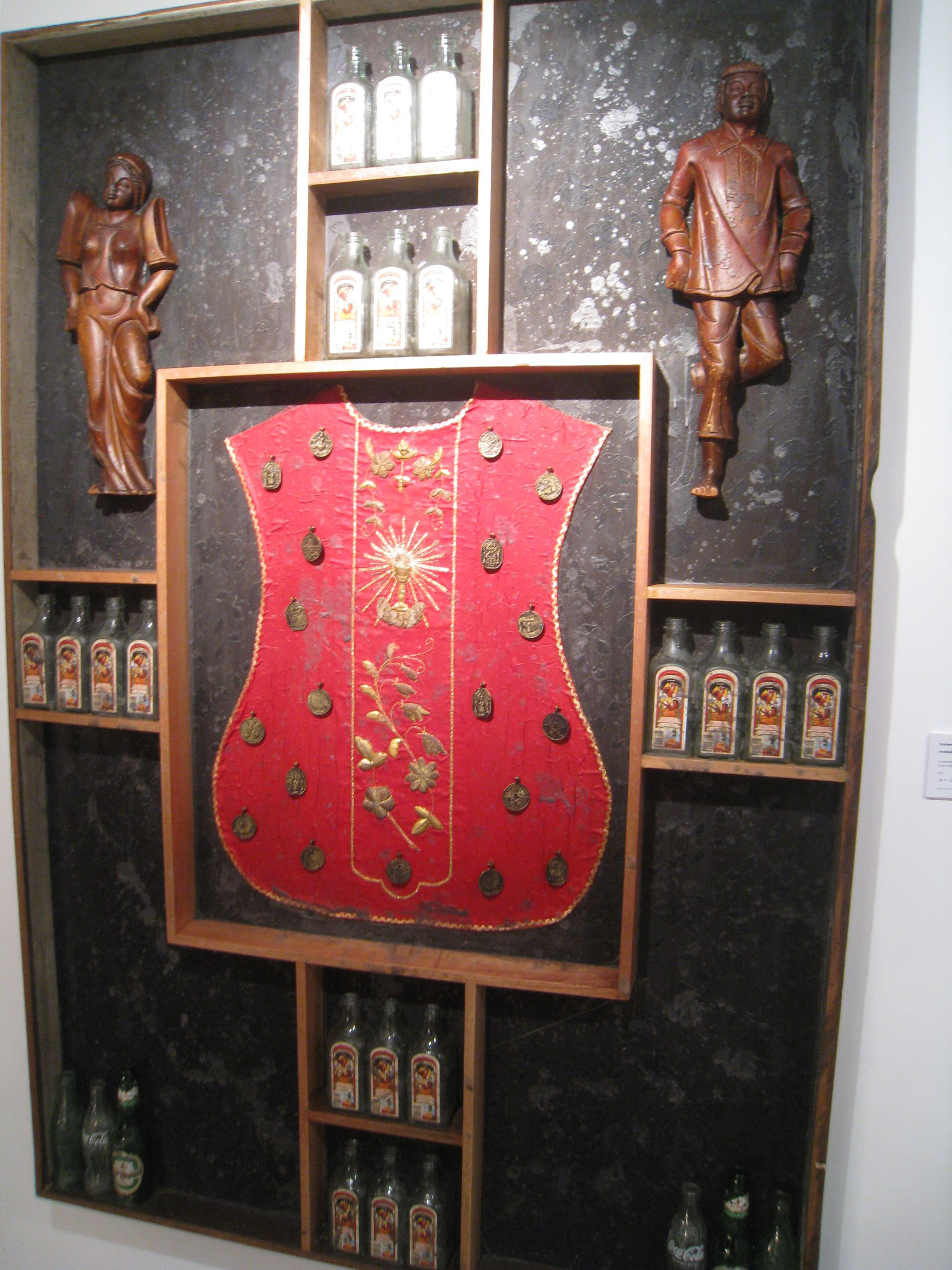
Norberto Roldan, "Invisibilitus Sum 2"
This month, Peewee brings out more of his boxed constructions, a continuation of his April exhibit at Green Papaya. Invisibilitus Est. 4, Invisibilitus Sum No. 1, and Invisibilitus Sum No. 2, again center on old chasubles. Peewee confides how difficult these have been to come by lately. He collected vintage studio shots for both What is the color of beauty? (1) and (2), the two largest pieces on view. Both diptychs, the first pits the old photographs against clippings from current fashion magazines, composed with a gathering of clear and colored old bottles. For the second, he has arranged more of these photos inside boxes. Peewee has encapsulated the stories of an era within the frames inside the piece.

Norberto Roldan, "What Is The Color of Faith 3"
My favorite pieces in the show belong to the series What Is The Color Of Faith? For the three pieces that make up this group of works, Peewee resurrected devices he has used in previous works. Amulets, neon figurines, and bottles filled with herbs and finished with carmen-carmen (square bits of cloth pinned on garments of infants to serve as protection) form crucifixes. Estampitas pasted on holograms create mesmerizing repetitions.

Norberto Roldan, "What Is The Color of Faith 3", detail
At the center of the gallery, a hundred used bottles of perfume inside an heirloom glass cabinet and two crystal chandeliers make up the installation Remembering My Mother’s Long Forgotten Scent.

Norberto Roldan, "What Is The Color of Faith 2"
Peewee’s pieces are social commentaries, discourses on our faith and history through collectibles. “I consider objects as possessing anthropological values. I cannot use an object merely on a whim… I put together old and new objects to signify the contemporary in the old,” Peewee explains his method of classifying his assemblages. “In the end, all the objects participate in making a whole narrative…and to me that’s what makes the work art. You’re not just telling a straight narrative but you are trying to break the narrative for people to make their own…each [person] can have their own reading of my pieces.”

Norberto Roldan, "What Is The Color of Faith 1", detail

Joaquin and Peewee Roldan with Triccie Luchangco and "What Is The Color of Faith 1"

Maxine Syjuco, "Propensity for Pain"
MAXINE SYJUCO: A PROPENSITY FOR PAIN
Quite coincidentally, the second exhibit currently running at Now has also made use of found photographs, their sepia tones complementing Peewee’s works. Maxine Syjuco printed a collection of discovered images on canvas. She concealed the faces in each of them, replacing visages with painted human hearts. Wooden frames that have been carved with wings complete each piece. “Because these people have long passed on,” Maxine explains, “I use the wings to set them free.” Could one also say that they have been transformed into angels?

Maxine Syjuco, "Sans The Seven Dwarves"
A sculpture of a small house atop an open book sits at the center of the room. Fabricated from wood and concrete, the doors and windows of the house stand wide open, ready to welcome Maxine’s liberated souls.

"A Propensity For Pain" installation view

Maxine Syjuco, "Prayers, Poems, Promises"
Norberto Roldan: The Beginning of History and Fatal Strategies and Maxine Syjuco: A Propensity for Pain run together with Pow Martinez: Nature Paintings from 12 August to 7 September 2011 at Now Gallery & Consulting, Unit M05, Mezzanine, Eco Plaza Bldg., 2305 Pasong Tamo Extension, Makati City. Phone (632) 555-0683 or visit http://www.nowgallery.net
An edited version of the write-up on Peewee’s show has been published in the August 2011 issue of Town and Country Philippines. Visit http://www.facebook.com/townandcountry.ph

Norberto Roldan, "What Is The Color of Faith 2", detail

Norberto Roldan, "Remembering My Mother's Long Forgotten Scent"

Norberto Roldan, "The Beginning Of History and Fatal Strategies"

Norberto Roldan, "Something To Remember Me By"
2 Comments | arts and culture, philippine contemporary art | Tagged: a propensity for pain, manila art blogger, maxine syjuco, norberto roldan, now gallery, pasong tamo extension, peewe roldan, philippine art, the beginning of history and fatal strategies | Permalink
Posted by manilaartblogger
Ateneo Art Awards 2011: Anatomy of Autonomy
August 12, 2011I look forward to the Ateneo Art Awards every year. I believe that it does a credible job of recognizing the best works by young visual artists. I do not always agree with their

Bembol dela Cruz and Kawayan de Guia
selections, and I do have an issue with the awards’ age limit. But overall, I still find it relevant and prestigious, a worthy acknowledgement of efforts undertaken in the past twelve months. All the chatter that rolls in along with the announcement of winners just adds to the fun! Yes we get names that appear every year— but doesn’t that just prove that those who always make it to the shortlist consistently do great work? A key component to the judging process requires artists to recreate an exhibit for the benefit of the panel of jurors. Yes, this imposes an onerous burden on the artists, one that the galleries must pitch in for. Having exhibits properly documented certainly helps. But it does prove difficult to capture an exhibit’s original flavor, despite the galleries’— and the artists’—best efforts. Perhaps, this should be addressed.
Since 2004, the Ateneo Art Gallery has bestowed the Ateneo Art Awards on three artists below the age of 36 who have exhibited outstanding work in the past year. A panel chooses the three winners from a shortlist of 12. The winners then have a chance at four overseas artist residency programs.

Bembol dela Cruz, "House Blends"
The Jorge B. Vargas Museum deserves a pat in the back as the unacknowledged fourth winner of this year’s awards. They mounted two of the three winning exhibits, and these serve as testaments to their programming. They have displayed a real commitment to showcasing the best of contemporary Philippine art. I even think that this year’s panel missed out on a third Vargas exhibit, one that should have been in the shortlist: Rodel Tapaya’s Bulaklak ng Dila (10 December 2010 to 5 March 2011). But that’s just me, kibitzing from the sidelines.
I have to admit,though, that I am more than happy with the two Vargas exhibits that won. Maria Taniguchi’s Echo Studies

Kawayan de Guia, "Bomba"
(30 March- 28 May 2011) definitely stood out as one of the most thought provoking of the group. Her works, contemplations on absent objects presented through drawings and a video installation, evince a fastidious and polished approach to art making. She has been awarded the residency to the Common Rooms Network Foundation in Bandung, Indonesia. Kawayan de Guia won his second Ateneo Art Award for Bomba (15 June-18 Dec 2010), his installation of disco mirror bombs that rotate along to the soundtrack of a video on porn and violence. If you ask me, he should have also won for his 2009 jukebox/jeepney pieces (from the exhibit Katas ng Pilipinas: God Knows Hudas Not Play). But I’ve stated before that I think these mirrored torpedoes are worthy successors to that series. He gets the La Trobe University Residency in Sydney.

Poklong Anading with a video from Maria Taniguchi's "Echo Studies"
Congratulations to Bembol dela Cruz for this much-needed shot in the arm! Bembol has continuously documented a subculture of skaters and tattoo artists through photorealistic paintings. He’s back in the radar with this win, for House Blends (Blanc Compound, 9 – 30 April 2011), an exhibit on anarchy via homemade bomb making. Bembol will undertake two of the residencies, in Singapore at Artesan, and in the UK, at the Liverpool Hope University, the first time this has been offered to the Ateneo Art Awards.

Ateneo Art Gallery's Richie Lerma and British Ambassador Stephen Lillie
The other artists on this year’s shortlist: Renato Barja Jr. (The Jungle and the Rain), Frank Callaghan (River of Our Dreams), Olivia d’Abboville (New Frontiers: Olivia D’Abboville, Chasm of Fantasies), Nona Garcia, (Fractures), Sam Kiyoumarsi (Inalienable Dreamless), Tatong Recheta Torres (Make My Day!), Rodel Tapaya (Simple Depictions), MM Yu (Waste Not Want Not), and Maria Jeona Zoleta (Sure Sure, Happy Happy, Picture Picture).
Kudos to the Ateneo Art Gallery headed by Richie Lerma and Yael Buencamino Borromeo! The Ateneo Art Awards turns eight this year, a worthy contributor to the enrichment of Manila’s art scene.
Ateneo Art Awards 2011 Anatomy of Autonomy runs from 5 to 15 August 2011 at the Grand Atrium of the Shangri-la Plaza Mall, Shaw Blvd, Mandaluyong City. The exhibition continues from 20 August to 10 September at the Ateneo Art Gallery, Ateneo de Manila University, Loyola Heights, Quezon City. Phone (632) 426-6488 or visit http://www.ateneoartgallery.org

Candy Reyes, Christina Dy, and Ateneo Art Gallery's Yael B. Borromeo

Tatong Recheta Torres and Tina Fernandez with "Make My Day"

Sidd Perez, Catalina Africa, and Maria Jeona Zoleta

Dex Fernandez stands beside pieces from Maria Jeona Zoleta, "Sure Sure, Happy Happy, Picture Picture"

From Olivia D'Abboville's "Chasm of Fantasies"
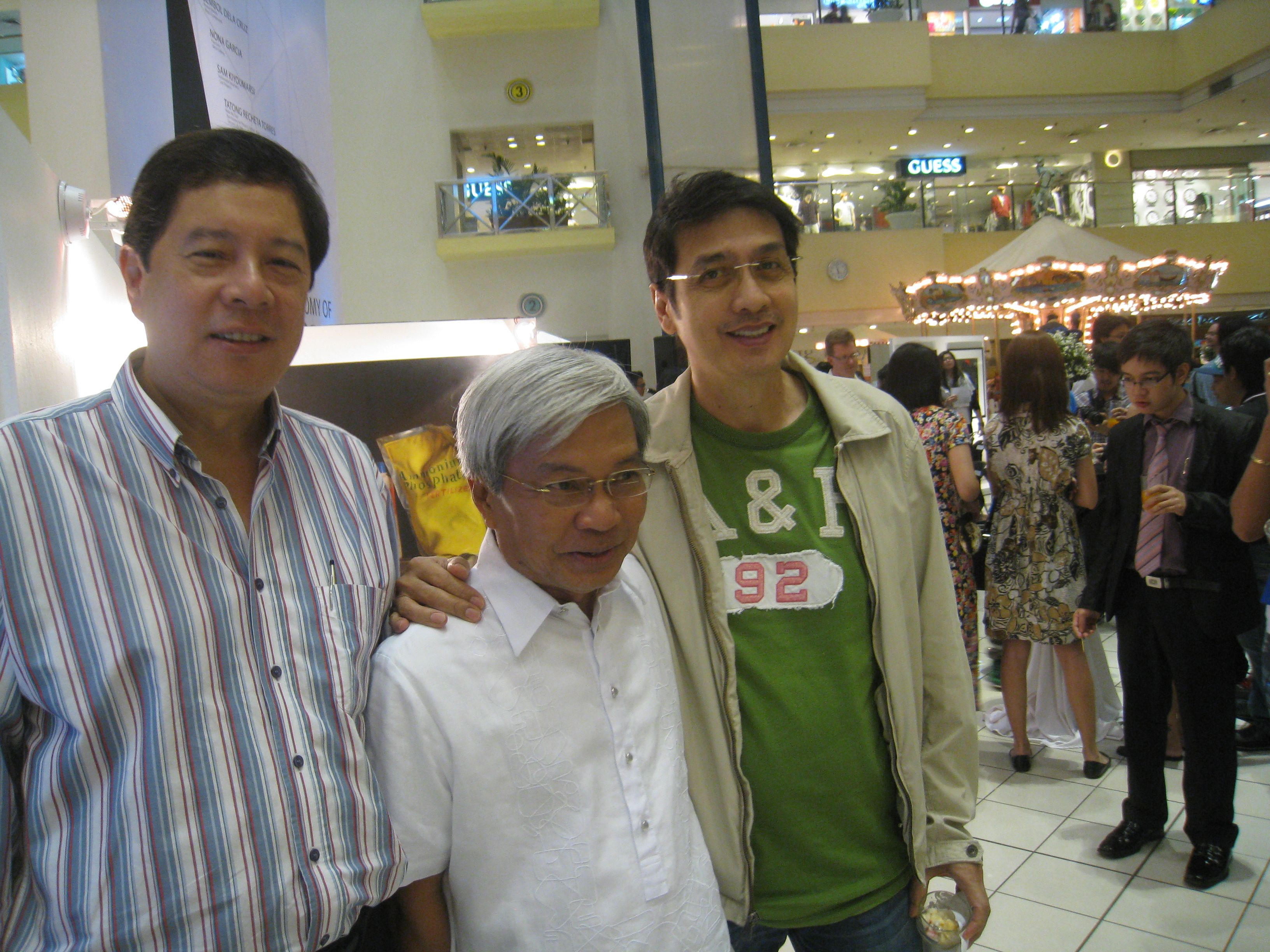
Ramon Roco, Dr. Leo Garcia, and Louie Ojeda

MM Yu, "Waste Not Want Not"

From Nona Garcia's "Fractures"

Renato Barja Jr., "The Jungle and the Rain"

Sculptures from Renato Barja Jr., "The Jungle and the Rain"

Rodel Tapaya, "Simple Depictions"

The crew behind the awards: JV Castro, Thea Garing, IC Jaucian, and Joel de Leon of the Ateneo Art Gallery

Alex Tan and Mike Tomacruz

Frank Callaghan, "River of Our Dreams"

Sam Kiyoumarsi and Eloha Laurel

Sam Kiyoumarshi, "Inalienable Dreamless"

From Sam Kiyoumarsi's "Inalienable Dreamless"
1 Comment | arts and culture, philippine contemporary art | Tagged: anatomy of autonomy, Ateneo Art Awards, ateneo art awards 2011, ateneo art awards 2011 winners, ateneo art awards winners, Ateneo Art Gallery | Permalink
Posted by manilaartblogger
Romeo Lee and Pow Martinez Wreak Mischief and Mayhem
August 9, 2011
Romeo Lee and his mural
The exhibit may have taken its name from Manuel Ocampo’s favorite wine, but Mischief and Mayhem perfectly suits the works of Romeo Lee and Pow Martinez. Those who follow these two know that their art hews closely to the messy, racy, and raunchy aesthetic, favored by the likes of Jonathan Meese and indeed, by Ocampo himself.

Another view of Romeo Lee's mural
The Department of Avant-Garde Clichés or DAGC Gallery supplies something fresh to Metro Manila’s art landscape. As the only gallery entirely devoted to prints and multiples, the folks behind it have brought our attention to the possibilities of extending printmaking to works of artists who lean to the lowbrow. These have

Examining Pow's prints
included artists from Spain and Germany. Like all who exhibit in the gallery, they showed pieces produced within the premises. One gets the impression that artists enjoy working in-house. Perhaps, this provides a break from their routines. The last exhibit, Misprint Messiahs, featured pieces by Louie Cordero and Carlo Ricafort. Prints and multiples also allow for more affordable pieces, perfect for the young urbanites who flock to the gallery.
Lee and Pow developed prints in black and white, pieces that complement Lee’s mural on the gallery’s long wall. Pow bound some of his images together, like a comic book one can flip through— a nice alternative to the works on paper installed on the walls.

Image inside Pow Martinez book
Mischief and Mayhem runs from 3 August to 17 September 2011 at The Department of Avant-Garde Cliches (DAGC Gallery), 2289 Pasong Tamo Extension, UPRC III Bldg, Makati. Phone (632) 8172042 or visit http://www.dagcgallery.com

Framed print by Pow Martinez

Framed print from Romeo Lee

Pow's books and another framed print
Leave a Comment » | arts and culture, philippine contemporary art | Tagged: dagc, dept of avant-garde cliches, manila art blogger, mischief and mayhem, pow martinez, romeo lee | Permalink
Posted by manilaartblogger
Brouhaha at the CCP
August 4, 2011 At first I was inclined to dismiss the debate as a tempest in a teapot. But when my favorite daily read (www.artdaily.com) carried the story of the furor over Mideo Cruz’s piece, Poleteismo, at the Cultural Center of the Philippines, I thought I had better make time to see for myself what the fuss was about. I admit, I had no plans to drive down to view Kulô, a group exhibit of UST alumni, during the show’s run. From photos I had seen of its opening night, I figured that majority of the artists who participated in the show chose to submit old works, most of them I had already seen before. But with the issue of blasphemy vs. artistic freedom dominating the headlines and television news programs, how can any observer of the Manila art scene not take a stand?
As has been said elsewhere, the merits and demerits of the piece, whether it can be classified as “good” art or not is beside the point (Frankly, I find Mideo’s performances more interesting). Other Filipino contemporary artists have expressed their disdain for the Catholic Church’s local hierarchy in stronger, more provocative terms. Although I personally did not find the piece offensive, I acknowledge that this may not be true for others (an understatement given the passions that have been ignited). But the artist deserves the right to express his views, especially one consistent with the exhibit’s concept. Calling his work illegal and immoral, and subjecting Mideo to harassment, should not be tolerated. It smacks of the Inquisition!
If it’s any consolation to Mideo, he stands in good company. One of Sandro Botticelli’s paintings served as kindle to Savonarola’s Bonfire of the Vanities in Renaissance Florence. The Taliban dynamited the Buddhas of Bamiyan in 2001 because they considered these ancient stone carvings as idols. Ignorance and mass hysteria have gone hand in hand before. The CCP has at least stood firm against any attempts to close the exhibit, and has chosen to encourage dialogue and debate instead. In that, they’ve done better than the Smithsonian. Late last year, the museum’s director caved in to pressure and removed a piece by artist David Wojnarowicz that had proved too controversial.
What a pity that this whole brouhaha has taken the attention away from Kulô. Despite my earlier reservations, I found that I enjoyed the show.
For more on the exhibit and Mideo’s piece, check out Sam Marcelo of Businessworld:
http://www.bworldonline.com/weekender/content.php?id=35478
The photo that appears on this post is taken from http://www.filipinofreethinkers.org
Postscript: I suppose it was too much to expect a government institution to stand steadfast against a bloodthirsty mob. The CCP Board decided to close the exhibit down five days after I originally posted this. Worse, all the politicians now think they can weigh in with their pompous opinions. How depressing that censorship and intolerance have prevailed.
1 Comment | arts and culture, philippine contemporary art | Tagged: Cultural Center of the Philippines, kulo, manila art blogger, mideo cruz, poleteismo | Permalink
Posted by manilaartblogger
 Snippets from the Manila Art Scene